
Wi-Fi 7: Multi-gigabit Wi-Fi is here!
go directly to the main content

Wi-Fi 7: Multi-gigabit Wi-Fi is here!
Even more speed with even more devices in the Wi-Fi network and even stabler connections
The first FRITZ!Box equipped with next-generation Wi‑Fi 7, FRITZ!Box 6670 Cable, is already on the market and more will follow. Wi-Fi 7 is ideal for real-time applications such as gaming, virtual reality or video calls. What makes it so special? We will give you a brief overview of the features of Wi-Fi 7.
Benefits for frequency bands and modulation
Wi-Fi 7 also introduces new technologies that increase the transmission rate and reliability in all Wi-Fi bands. The new, higher 4K-QAM (4096) modulation offers significantly better performance – improved by more than 20%.
Simultaneous transmission on multiple bands
Multi Link Operation (MLO) enables wireless devices with Wi-Fi 7 to transmit and receive data on several frequency bands simultaneously. Whereas previously, switching from one band to another required a certain amount of time and resources, thanks to dual-band concurrent technology, devices that support MLO can actively maintain two connections on two bands at the same time. Low latency, fast band switching in case of interference, and additive (higher) bandwidth are the result.
Additional 6-GHz frequency band
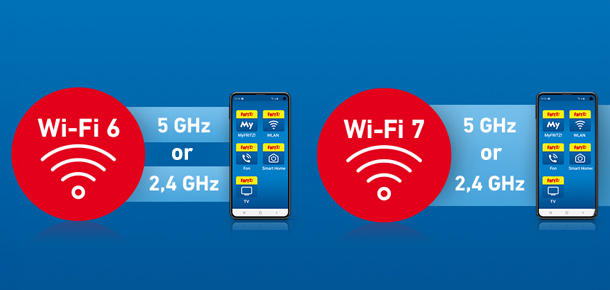
In addition to the 2.4- and 5-GHz frequency bands, Wi-Fi 7 also unleashes the full potential of the 6-GHz band. This opens up a new, incredibly wide and interference-free superhighway at 500 MHz, without any gaps. A further advantage of the new frequency band: Radar is no longer a problem.
5 times faster than Wi-Fi 6
Thanks to the many individual enhancements to the standard, maximum gross data rates of up to 46 Gbit/s can be achieved.
Interference that's barely noticeable
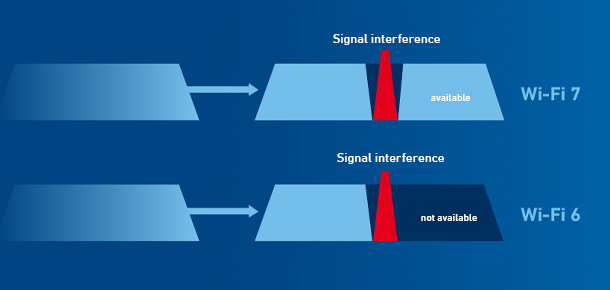
Neighbouring Wi-Fi networks or devices such as microwaves can cause interference. ‘Punctured mode’ targets frequency ranges that are causing interference and removes them from the frequency spectrum. Instead of closing the entire information highway, only the median strip is closed. Everything else can carry on down the highway uninterrupted.
Double the bandwidth with 6 GHz
Compared to the 5-GHz range, the maximum channel bandwidth with 6 GHz and Wi-Fi 7 doubles to 320 MHz, providing massive gains for data rates.
Fully backward compatible
The new Wi-Fi 7 standard adapts to your current environment and also works perfectly with all older wireless devices.
Feature comparison of Wi-Fi 7/6(E)/5/4
|
W-Fi 7 |
Wi-Fi 6/6E |
Wi-Fi 5 |
Wi-Fi 4 |
|
|---|---|---|---|---|
|
Supported frequency bands |
2.4 GHz, 5 GHz, 6 GHz |
2.4 GHz, 5 GHz, 6 GHz |
5 GHz |
2.4 GHz, 5 GHz |
|
Channel bandwidth in MHz |
20, 40, 80, 160, (320 in 6 GHz only) |
20, 40, 80, 160 |
20, 40, 80, 160 |
20, 40 |
|
Clients per access point |
> 400 |
200–400 |
50–100 |
< 50 |
|
Modulation |
4096-QAM |
1024-QAM |
256-QAM |
64-QAM |
|
Data rate (theoretical maximum) |
~46 Gbit/s |
9.6 Gbit/s |
6.9 Gbit/s |
0.6 Gbit/s |
This makes Wi-Fi 7 with FRITZ! so special:
- Wi-Fi 7 is perfectly integrated into the FRITZ! ecosystem – all wireless devices work together optimally in the Mesh Wi-Fi to deliver top speeds.
- Wi-Fi 7 is the next step! Benefit from continuous improvements in the future thanks to free updates.
- FRITZ! devices strike a balance between maximum energy efficiency and maximum performance. This way, you can keep your electricity costs down and support sustainability with FRITZ!.
Have any questions?
We're happy to answer them for you! You can find out how to get in touch with your contact person under Contact.
 Deutschland
 Österreich
 España
 Schweiz
 Italia
 Nederland