
The WindTre and FRITZ! business case
go directly to the main content
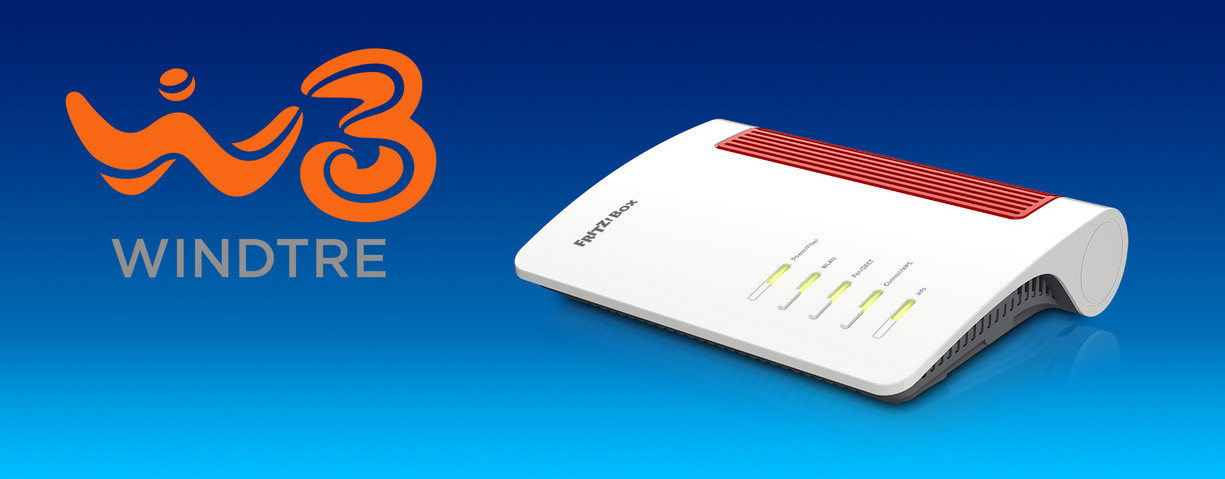
The WindTre and FRITZ! business case
🇮🇹 The expectations of Italian micro business customers are rapidly increasing with regard to in-premises performance, security, and reliability. Access speed alone is no longer sufficient: Service quality is increasingly defined by Wi-Fi coverage, device density, segmentation, and the ability to deploy and operate connectivity at scale with minimal support load.
WindTre's evolution in business fiber, supported by the integration of FRITZ! CPE and the FRITZ!OS software ecosystem, creates an operator-grade model that combines:
- High-performance access (including Super Fibra up to 2.5 Gbit/s),
- premium in-premises experience (with Wi-Fi 7 and multi-gigabit LAN), and
- operational simplicity that supports lower lifecycle cost and higher customer satisfaction.
This document outlines the operator rationale, the target business use cases, and the enablement framework to support go-to-market execution.
1. Market drivers: What businesses must solve in B2B connectivity
Across micro businesses, network requirements have shifted in structural ways:
- The site is the product: The service experience is now heavily dependent on internal Wi-Fi and LAN performance to support cloud applications and video collaboration.
- High density and concurrency: Micro businesses frequently host many connected devices (PCs, IoT, POSs), necessitating robust networks with no coverage constraints.
- Security and segmentation: Customers require strict logical separation and controlled connectivity between office operations, production, guest users, and payment systems.
2. The WindTre + FRITZ! approach (operator value proposition)

The Wind Tre-FRITZ! model is designed for a business operating reality: Consistent service quality at scale, with predictable deployment and a stronger end customer outcome.
2.1 ‘Triple win strategy’ for B2B
- WindTre: Lower operational friction through a stable, feature-rich CPE platform; improved customer experience reduces churn and support load.
- Business customer: Enterprise-grade Wi-Fi, security, and communication features aligned to real workflows, not only bandwidth.
- FRITZ!: Consolidation of a reference CPE standard via FRITZ!OS and a coherent ecosystem.
3. Representative B2B scenarios (micro business)
The following scenarios illustrate typical requirements that drive cost-to-serve:
- Scenario A: Small retail / point of sale: Requires reliable Wi‑Fi coverage, traffic prioritization, and segmentation to isolate POS/payment systems from guest Wi‑Fi.
- Scenario B: Professional studio (law/accounting/agency): Relies on stable connectivity for cloud apps, video calls, and secure remote access (VPN) for occasional hybrid work.
- Scenario C: Café / small hospitality: Needs high-density guest Wi‑Fi isolation and traffic policies to protect business-critical bandwidth and back-office operations.
- Scenario D: Small clinic / wellness practice: Benefits from integrated telephony/PBX features and secure segmentation between staff devices and guest/patient access.
4. Reference CPE portfolio for business outcomes
WindTre's positioning benefits from a clear, tiered CPE story anchored in a flagship device:
- FRITZ!Box 7690: Designed for demanding, high-density sites, featuring Wi‑Fi 7 (dual-band, 4x4), 2.5-Gbit/s LAN/WAN for multi-gigabit capacity, and integrated DECT base capabilities.
5. Operational impact for micro businesses (what this enables)
This model supports measurable outcomes across the customer lifecycle:
- Faster, more repeatable deployments: A consistent CPE portfolio reduces installation variations.
- Lower cost-to-serve: Improved in-premises stability reduces support calls and on-site interventions.
- Better customer experience and retention: Higher perceived service quality and fewer reachability complaints.
- Upsell-ready propositions: Ability to bundle premium Wi-Fi and integrated communications for higher ARPU.
6. Go-to-market enablement: FRITZ! support for business execution
To help WindTre scale the proposition, FRITZ! provides practical enablement:
- FRITZ! expert sessions for complex B2B deals: Direct access to FRITZ! specialists to validate designs and accelerate pre-sales.
- Digital onboarding assets: Materials such as ad hoc videos, Canvas software, and editorial elements that reduce post-sale friction and improve first-time success.
- Continuous training and webinars: Structured updates on Wi-Fi 7 and positioning, ensuring consistent field messaging.
Conclusion
For businesses addressing micro businesses, differentiation increasingly depends on controlling the in-premises experience, Wi-Fi quality, segmentation, stability, and operational simplicity, not only access speeds. The WindTre + FRITZ! model demonstrates a scalable path to deliver a premium business connectivity experience while supporting efficiency and stronger commercial positioning.
Have any questions?
We're happy to answer them for you! You can find out how to get in touch with your contact person under Contact.
 Deutschland
 Österreich
 España
 Schweiz
 Italia
 Nederland